
The payment ledger
A debt’s current balance is always the original balance minus the sum of every payment recorded against it — never a number edited directly. That holds whether or not the debt is linked to an account: only recorded payments move what’s owed. Payments are recorded one of two ways:
- Manually, entering an amount and date yourself.
- By tagging a real transaction as a payment toward the debt, defaulting to that transaction’s amount and date. A transaction can only pay down one debt, and you can tag a partial amount if the transaction covered more than just this payment.
A debt entered part-paid — which is most of them — starts wherever you say it currently stands, with that starting gap recorded as the ledger’s own opening entry, so the balance and the history behind it agree from day one. Naming an account on a debt (a credit card or loan account you’re also tracking) is a label for reference only; it never moves the balance on its own, and neither does unlinking it.
Payoff plans: snowball, avalanche, or your own order
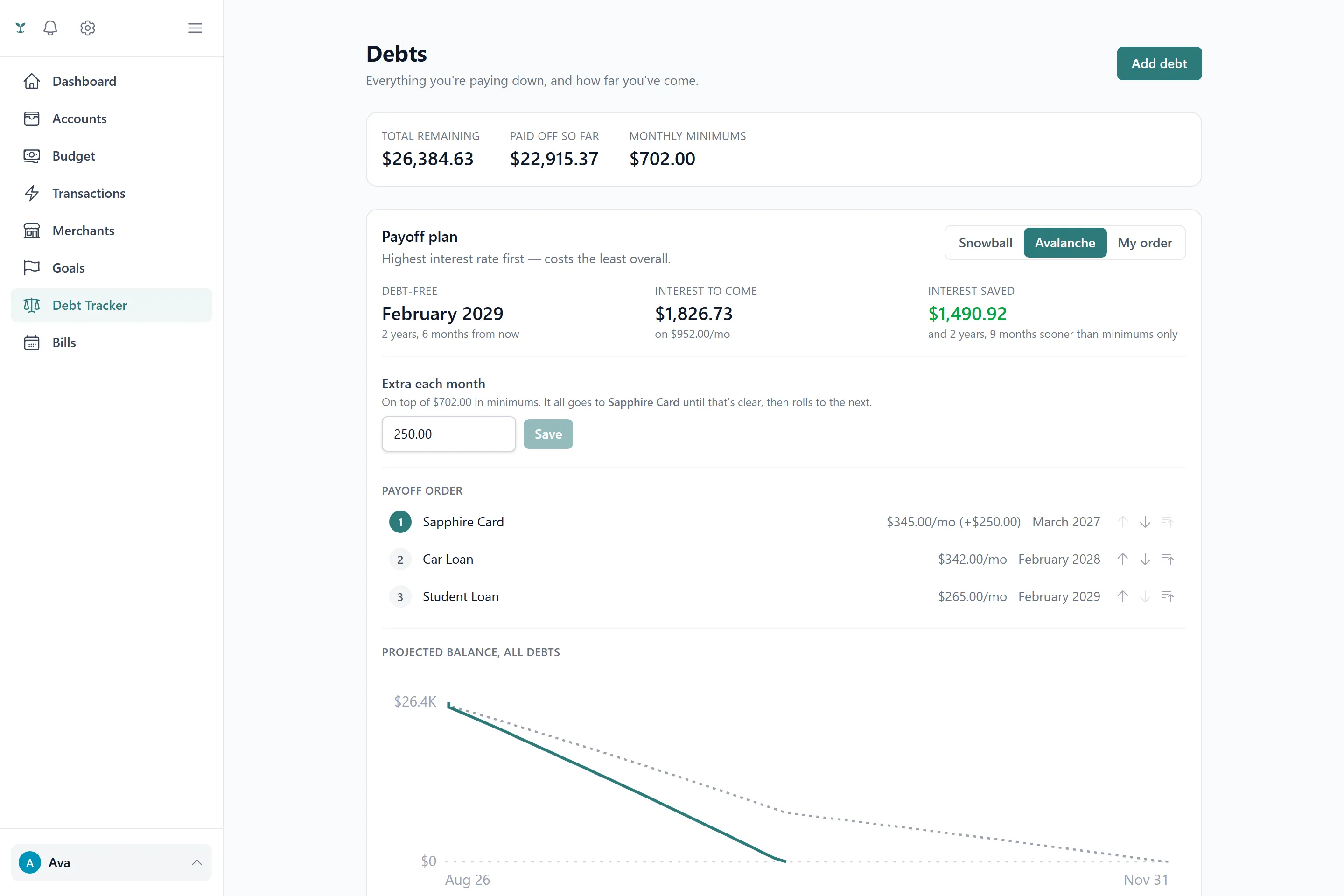
The payoff plan projects how long a debt-free date is and how much interest you’ll pay under three approaches — snowball (smallest balance first), avalanche (highest interest rate first), or an order you set yourself — plus an extra monthly payment amount on top of everyone’s minimums. All three strategies are calculated live, every time you look, rather than only the one you’ve saved: switching between them to compare is instant, and doesn’t require committing to anything or waiting on a recalculation. Only the choice of which strategy your budget and dashboard should reflect is actually saved.
The projection never touches what you actually owe — it’s a read-only forecast over the payment ledger, not a plan that pays anything down itself. As debts clear under a rollover strategy, whatever they were absorbing (their minimum, plus whatever extra was pointed at them) rolls onto the next debt in line — the mechanic that makes the snowball and avalanche approaches build momentum over time. Interest is modeled monthly against a debt’s APR, matching how it’s shown elsewhere in the app rather than compounding daily, since agreeing with the number you saw a screen earlier matters more than a fraction of a percent of precision. A plan that wouldn’t clear within fifty years is reported as not payable off within any reasonable horizon rather than a date decades from now.
Reminders
A debt can be linked to a recurring bill so its minimum payment and due date show up as a reminder — see Recurring bills for how the reminder schedule and emails work. The link only pushes information one way, from the debt to the bill: nothing the bill tracks can ever mark a debt as paid down or move its balance. Payoff progress comes only from the payment ledger, so a reminder you paused, deleted, or never confirmed can’t make a debt look further along than it actually is.